Tina Blau
Modern and Dauntless – A 19th Century Artist’s Personal Path
In November 1845 Regina Leopoldine Blau, known as Tina Blau, daughter of a military doctor from Prague (†1916), was born in Vienna. Blau, whose artistic ambitions were supported by her father, courageously pursued her path and is known today as one of the most famous landscape painters of 19th century Austria.
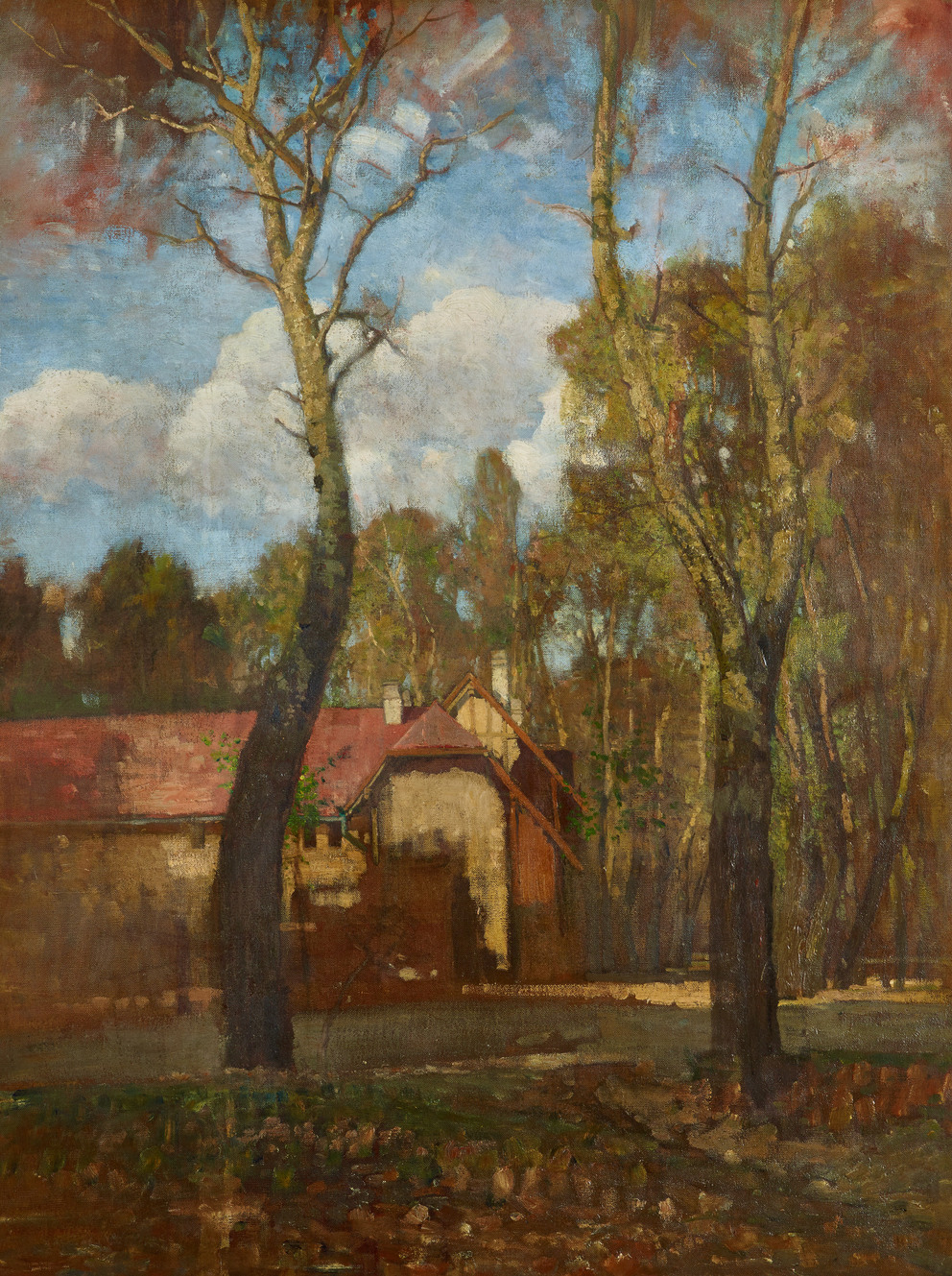
Not only was it neither easy nor self-evident to become an artist as a woman at the time – women were generally denied creative power as well as an academic education –, Blau, who was taking private lessons with August Schaeffer (1833-1916), among others, even went a step further. Instead of primarily painting her artworks in a studio, she preferred being out in nature, directly on site, to capture her motifs on canvas, as for example in the Prater Scene, where she shared a painting studio close by with Emil Jakob Schindler (1842-1892) from 1877 onwards. As a plein air painter she was an exception amongst her peers around 1900.
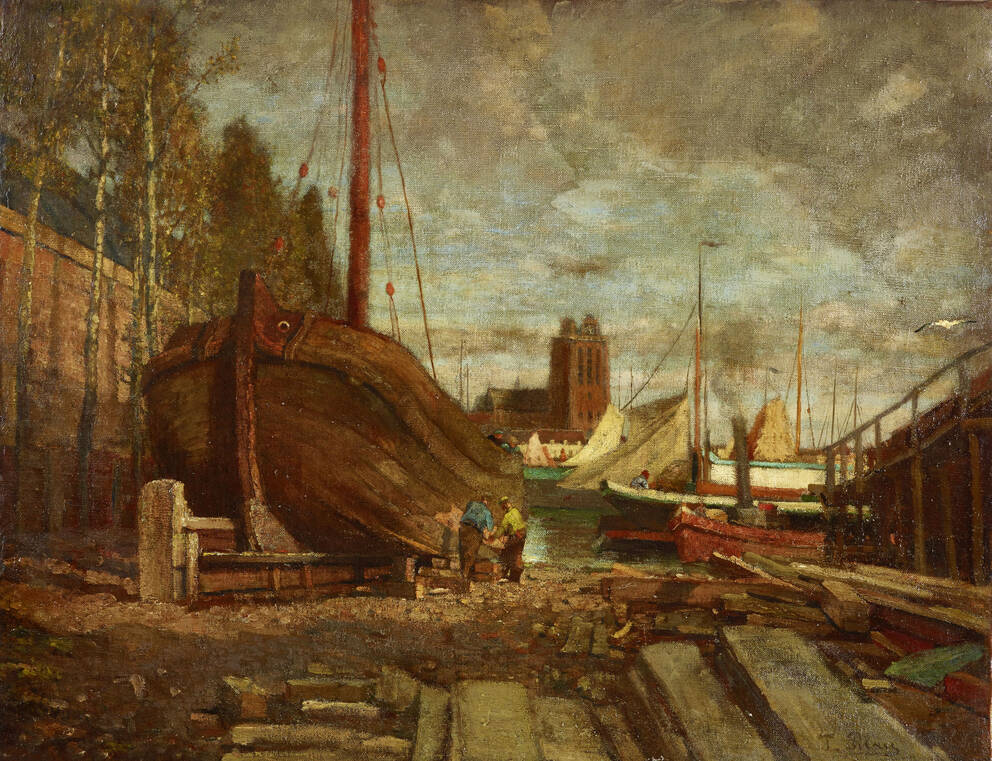
In order to gather new impressions and experiences, she travelled – often on her own – to Italy, Holland (see: Shipyard in Dordrecht, Canal in Holland, Dutch Landscape), Hungary and Germany, where she stayed in Munich for a longer period of time from 1869 onwards and started teaching at the Damenakademie des Müncher Küstlerinnenvereins (the Women’s Academy of the Munich Women Artists’ Association) in 1887.
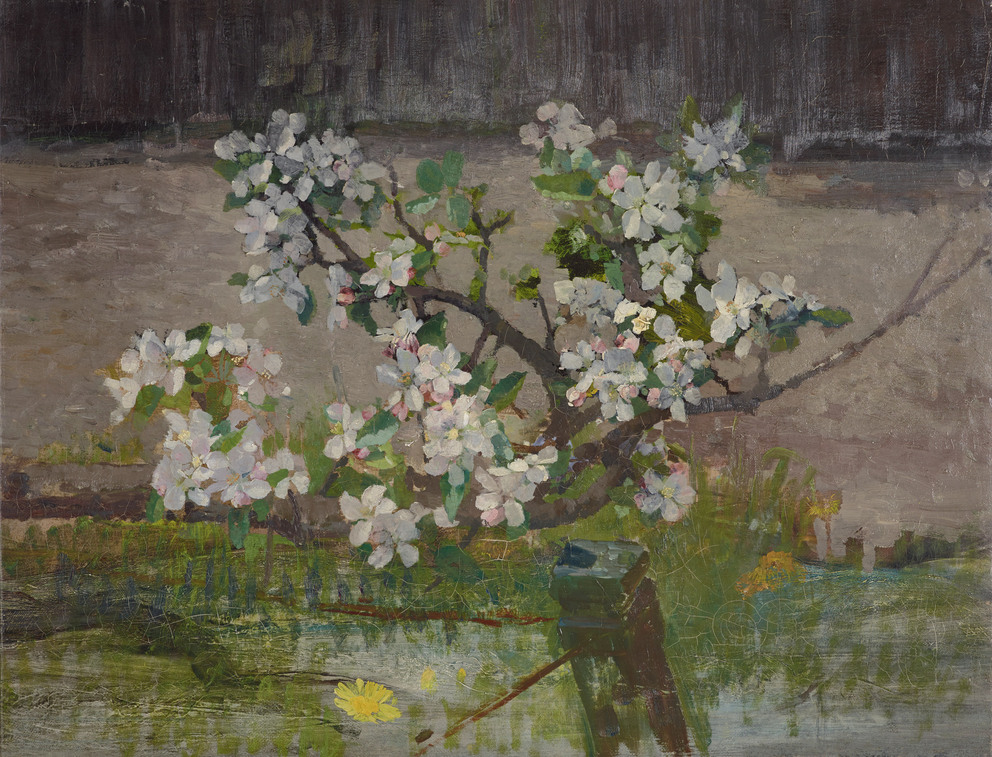
Through her study trips she not only managed to broaden the spectrum of her motifs, the different lighting conditions and phenomena also shaped her paintings created abroad. Blau’s way of painting is characterised on the one hand by precision and attention to detail, and on the other – especially in her oil studies – by a brisk and open brushstroke. Standing out as well is her interest technicised landscapes: Blau took an interest among other things in the excavations and remodelling of the 1870 Danube river regulation, with whose depictions she participated in the Wiener Weltausstellung [Vienna World’s Fair] in 1873, as well as with motifs of sand pits, tanneries or railway constructions. Thus, thematically moving into a masculine terrain. Independence and autonomy where of utmost importance to the artist, who received a grave of honour at the protestant cemetery in Simmering. KJ, 2026
Not only was it neither easy nor self-evident to become an artist as a woman at the time – women were generally denied creative power as well as an academic education –, Blau, who was taking private lessons with August Schaeffer (1833-1916), among others, even went a step further. Instead of primarily painting her artworks in a studio, she preferred being out in nature, directly on site, to capture her motifs on canvas, as for example in the Prater Scene, where she shared a painting studio close by with Emil Jakob Schindler (1842-1892) from 1877 onwards. As a plein air painter she was an exception amongst her peers around 1900.
In order to gather new impressions and experiences, she travelled – often on her own – to Italy, Holland (see: Shipyard in Dordrecht, Canal in Holland, Dutch Landscape), Hungary and Germany, where she stayed in Munich for a longer period of time from 1869 onwards and started teaching at the Damenakademie des Müncher Küstlerinnenvereins (the Women’s Academy of the Munich Women Artists’ Association) in 1887.
Through her study trips she not only managed to broaden the spectrum of her motifs, the different lighting conditions and phenomena also shaped her paintings created abroad. Blau’s way of painting is characterised on the one hand by precision and attention to detail, and on the other – especially in her oil studies – by a brisk and open brushstroke. Standing out as well is her interest technicised landscapes: Blau took an interest among other things in the excavations and remodelling of the 1870 Danube river regulation, with whose depictions she participated in the Wiener Weltausstellung [Vienna World’s Fair] in 1873, as well as with motifs of sand pits, tanneries or railway constructions. Thus, thematically moving into a masculine terrain. Independence and autonomy where of utmost importance to the artist, who received a grave of honour at the protestant cemetery in Simmering. KJ, 2026